

Waterproof Garden Furniture Covers: The Ultimate UK Protection Guide
Your garden furniture cover is failing. It’s not just the relentless UK downpours or the gale-force winds that are the problem; it’s the fundamental design and material of the cover itself. You invest hundreds, sometimes thousands, of pounds in a beautiful outdoor set, only to face the frustration of covers that rip after a single winter, or worse, trap condensation that leaves your cushions damp and mildewed.
This guide is your new strategy. Forget guesswork and disappointing purchases. Here, you’ll discover exactly how to select high-performance waterproof garden furniture covers that provide a true, impenetrable shield for your outdoor investment. We promise to reveal the specific materials that actually work, the correct way to measure for a wind-proof fit (even for awkward corner sofas), and the essential features that guarantee your furniture emerges pristine season after season. We'll break down the critical difference between 600D and 300D polyester, explain why air vents are non-negotiable, and show you the securing systems that stay put.
Key Takeaways
- Learn the crucial difference between 'waterproof' and 'water-resistant' to ensure your waterproof garden furniture covers can truly handle a British downpour.
- Understand the technical specs like fabric denier (e.g., 600D) and coatings to choose a cover that genuinely repels water, not just absorbs it.
- Master the correct measuring technique for a perfect fit, preventing the unexpected damage that both overly tight and loose covers can cause.
- Discover why breathability is just as important as waterproofing and how to stop the hidden threat of mould from ruining your cushions.
The Essential Role of Waterproof Garden Furniture Covers in the UK
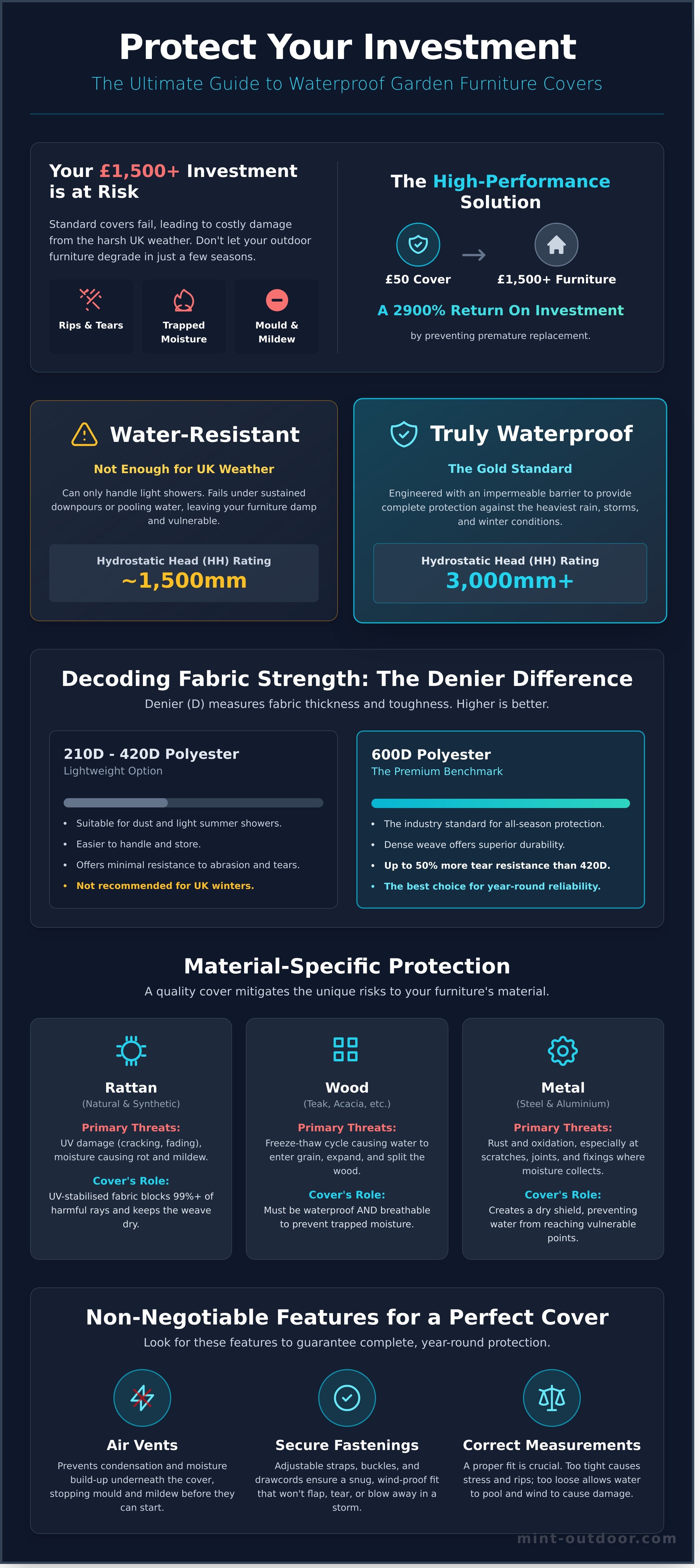
Your garden furniture is a significant investment. A premium rattan sofa set or a stylish wooden dining table can easily cost upwards of £1,500. Yet, many owners leave this investment exposed to the single greatest threat in the UK: the weather. The financial logic is simple and undeniable. Spending £50 on a high-performance cover isn't an expense; it's a strategic move that safeguards your primary asset, delivering a 2900% return on investment by preventing premature replacement. Year-round protection from rain, UV rays, and frost is the difference between furniture that lasts a decade and furniture that degrades in just three seasons.
Effective protection starts with understanding a critical distinction. In the face of relentless British downpours, "water-resistant" is simply not enough. It’s a term for materials that can repel a light shower, but will inevitably fail under sustained pressure. True security comes from fully waterproof garden furniture covers, engineered to provide an impermeable barrier against the elements. This ensures your outdoor living space remains ready to use and visually pristine, year after year.
Why Water-Resistance Isn’t Enough for British Winters
The technical measure for a fabric's water protection is its hydrostatic head (HH) rating. A basic showerproof cover may have a 1,500mm HH rating, but this is insufficient for pooling water on a flat tabletop or the driving, horizontal rain of an autumn storm. For guaranteed protection, a minimum 3,000mm HH is essential. With meteorological models projecting wetter and more volatile weather patterns through 2026, investing in higher durability standards is no longer an option, it's a necessity.
Protecting Different Materials: Rattan, Wood, and Metal
Every material used in outdoor furniture reacts differently to prolonged exposure. While there are many common garden furniture materials, they all share a vulnerability to the UK climate. A purpose-built cover is designed to mitigate these specific risks, providing tailored protection that maximises longevity.
- Rattan: Moisture is the enemy of natural rattan, seeping into the weave and causing rot and mildew from the inside out. For synthetic PE rattan, the primary threat is UV radiation, which causes the plastic to become brittle, faded, and cracked. A UV-stabilised cover blocks over 99% of harmful rays and keeps the weave dry.
- Metal: Even powder-coated steel frames will rust rapidly once a small scratch exposes the metal beneath. Aluminium doesn't rust but will oxidise, creating a pitted, chalky surface. A cover prevents moisture from settling in joints and on fixings, which are the most common points of failure.
- Wood: Timber is highly susceptible to the freeze-thaw cycle. Water penetrates the grain, freezes, expands, and causes splits and warping. A quality cover must be both waterproof and breathable. Vented designs prevent condensation build-up, allowing the wood to acclimate to temperature shifts without trapping destructive moisture against the surface.
Ultimately, year-round coverage is the most effective strategy for asset preservation. It stops cosmetic damage like fading and staining, but more critically, it prevents the structural degradation that leads to costly repairs and replacements. Your furniture remains in prime condition, ready for the first sunny day of spring.
Decoding Materials: What Makes a Garden Furniture Cover Truly 'Waterproof'?
The term 'waterproof' is used frequently, but not all covers are created equal. True, lasting protection isn't found in a single material but in a precisely engineered system. It’s the synergy between the base fabric, the protective coating, and the construction quality that separates a temporary shield from a fortress for your furniture. Understanding these components is essential to investing wisely.
Heavy-Duty vs. Lightweight Fabrics
The foundation of any high-quality cover is its fabric, typically a polyester Oxford weave. The strength of this weave is measured in Denier (D). Denier is a unit of measurement for the linear mass density of fibres, essentially defining the weight and thickness of the fabric weave. A higher number means a tougher, more resilient material.
- 210D-420D Fabrics: These are lightweight options, perfect for shielding furniture from summer showers and dust. They are easy to handle and store but offer minimal resistance against abrasion or the harsh conditions of a UK winter.
- 600D Polyester: This is the industry benchmark for premium, all-season waterproof garden furniture covers. With a dense weave offering up to 50% more tear resistance than 420D alternatives, 600D fabric provides the structural integrity needed to withstand high winds, heavy snow, and accidental snags.
For long-term visual appeal, look for "solution-dyed" fabrics. In this process, pigment is added before the yarn is created, locking in colour at a molecular level. This technique prevents fading for an average of 3-5 years longer than standard surface-dyed materials, ensuring your cover looks as good as it performs.
The Science of Coatings and Linings
The raw fabric provides strength, but the coating delivers the water resistance. The two most common options are Polyurethane (PU) and Polyvinyl Chloride (PVC), each with distinct performance profiles.
A PU coating is applied as a thin, flexible layer that works on a microporous level. It’s engineered to be impermeable to liquid water but permeable to water vapour. This breathability is critical; it allows condensation trapped under the cover to escape, preventing the growth of mould and mildew that can damage your furniture. This technology is at the core of high-performance waterproof breathable fabrics, which are designed to manage moisture effectively. Its flexibility also means it won't stiffen or crack in temperatures down to -20°C.
In contrast, a PVC backing provides a solid, non-breathable barrier. While it offers 100% water blockage initially, its lack of breathability can trap damp air, creating a perfect environment for mould. More critically, PVC becomes brittle in the cold and is known to crack in temperatures below 5°C, a frequent occurrence during British winters, leading to catastrophic failure.
Finally, inspect the seams. A cover made from the best materials is useless if its stitching leaks. Every stitch is a potential entry point for water. Premium covers feature taped or heat-welded seams, creating a continuous, impenetrable barrier that guarantees total waterproofing. A cover without sealed seams will fail in the first sustained downpour. Understanding these technical details is the first step; to see them in action, explore our premium range of protective solutions engineered for the UK climate.
Measuring and Fitting: Ensuring Your Patio Set is Fully Protected
Investing in a cover is only half the battle. The single most critical factor for effective, long-term protection is the fit. Think of it as the "Goldilocks" principle: a cover that's too tight will strain seams and zippers, leading to premature rips, especially during frosty weather. One that's too loose becomes a sail in high winds, flapping against your furniture and potentially flying off entirely, leaving your investment exposed. A precise fit ensures your waterproof garden furniture covers perform exactly as designed.
Achieving this perfect fit is straightforward. You'll need a flexible tape measure and a notepad. For every piece of furniture, measure the three key dimensions:
- Length (L): Always measure the longest point from side to side.
- Width (W): Measure the widest point from front to back.
- Height (H): Measure from the ground to the very highest point of the furniture.
How to Measure Corner and L-Shaped Sofa Sets
Corner sofas present a unique challenge, but a methodical approach guarantees accuracy. Instead of viewing it as one complex shape, break it down. Measure the overall length of each side, starting from the outermost corner and extending to the end of the armrest. Then, measure the depth (from the front of the cushion to the back of the frame) and the height. Always use the longest and tallest measurements to ensure no corners are left exposed to the elements. For a visual guide, you can compare your measurements against the specifications on our premium corner garden sofa sets.
Dealing with Unusual Shapes and Accessories
Your garden's character often comes from its unique pieces. For items like parasols, measure the height and the diameter when closed. For sun loungers, capture the total length, width, and height at the headrest. When measuring your outdoor dining sets, always push the chairs in fully to get the most compact footprint. A vital tip for all furniture is to choose a cover that is 2-5cm shorter than the furniture's height. This small gap promotes essential airflow, preventing condensation and mildew from forming underneath.
Securing Your Cover and Preventing Water Pooling
A perfect fit is useless if the cover won't stay put. Look for covers equipped with robust fastening systems. An adjustable drawstring around the base allows you to cinch the hem for a snug fit, while click-close buckled straps that loop around furniture legs are non-negotiable for preventing wind lift. These features work together to create a sealed, secure barrier.
For large, flat surfaces like dining tables, rainwater can collect in the middle, creating a heavy pool. While high-quality waterproof fabrics are engineered to repel moisture, this pooling can strain the material over time. The solution is simple: create a high point. Place a small, inflatable beach ball or a purpose-made water-shedding pole in the centre of the table before covering it. This creates a tent-like effect, ensuring water runs straight off and your furniture stays perfectly dry.
The Breathability Factor: Preventing Mould and Mildew Under Your Cover
You’ve likely heard the common objection: "I used a cover, and my cushions still went mouldy." This is a valid concern, but it misdiagnoses the problem. The culprit isn't the act of covering your furniture; it's the use of a non-breathable, low-quality cover that traps moisture. A premium cover works differently. It creates a microclimate that protects, but also breathes.
The core issue is condensation. As temperatures fluctuate throughout the day and night, the air trapped under a cover cools. When it reaches its dew point, moisture is released from the air and settles as condensation on your furniture frames and cushions. In a sealed, non-breathable environment, this dampness has nowhere to go. It becomes a breeding ground for mould, mildew, and unpleasant odours. This is precisely why breathability is a non-negotiable feature in high-performance waterproof garden furniture covers.
Ventilation Features to Look For
A truly effective cover manages airflow with intelligent design. Look for built-in, covered mesh air vents. These are not simple holes; they are strategically placed panels that allow water vapour and stale air to escape while an overlapping fabric flap prevents rain from entering. This system facilitates a "chimney effect." As warmer, humid air rises inside the cover, it exits through the upper vents, which in turn draws cooler, drier air in from the bottom. This constant, passive circulation is critical for keeping the internal environment dry and hostile to mould growth.
Best Practices for Winter Storage
Even the best cover needs a little help to perform optimally, especially during the long, damp UK winter. Following a few simple rules will guarantee your furniture emerges in spring looking pristine.
- Never cover damp furniture. This is the cardinal rule. Trapping existing moisture is a fast track to mildew. Always ensure your furniture and cushions are completely dry after a final clean before covering them for the season.
- Create a high point. Don't let your cover lie flat on a tabletop. Water can pool in dips and place immense stress on the seams. Use a small bucket, an inflatable beach ball, or a dedicated cover "lifter" in the centre to create a raised point. This ensures water runs off immediately, just like a tent.
- Assess your cushions. If last year's storage efforts failed and your cushions are already showing signs of mould or deterioration, it might be time for an upgrade. A new set of replacement garden furniture cushion sets can revitalise your entire garden setup.
While our breathable covers offer excellent protection for cushions during intermittent showers, for extended periods like winter, the ultimate strategy is to remove them. Storing cushions indoors or in a purpose-built outdoor storage box provides a 100% guarantee against moisture damage. Think of your waterproof garden furniture covers as the primary shield for your frames and tabletops, with cushion storage as your secondary line of defence.
Don't let condensation compromise your investment. By choosing a cover with superior ventilation and following these best practices, you ensure total protection without the risk of mould. Explore our collection of breathable, heavy-duty covers and give your furniture the intelligent protection it deserves.
MINT Outdoor: Premium Protective Solutions for Every Garden Set
Your garden furniture is more than just an item; it’s the centrepiece of your outdoor life. Protecting that investment shouldn’t be an afterthought. At MINT Outdoor, we’ve engineered a specialist range of protective covers designed not just to shield your furniture, but to preserve its integrity and aesthetic for years to come. We believe protection should be as premium as the product it covers.
The key advantage lies in precision. A generic, ill-fitting cover can do more harm than good, trapping moisture and creating pools of stagnant water that accelerate wear. Our covers are designed to complement specific MINT Outdoor collections, ensuring a snug, tailored fit that prevents wind-whipping and moisture ingress. This bespoke approach is the first line of defence against the UK’s notoriously unpredictable climate.
Every cover we produce meets our rigorous 600D heavy-duty standard. This isn’t just a number; it’s a guarantee of resilience. Crafted from 600 Denier Oxford fabric with a waterproof PVC lining, our covers offer superior tear resistance and total protection against rain, frost, and UV damage. This is the quality standard required to withstand British weather, season after season.
Integrating our covers into your garden maintenance routine is simple but effective. Before covering, ensure your furniture is clean and completely dry to prevent mould. Use the integrated drawstrings to secure the cover tightly at the base. This simple, two-minute process extends the life of your set, ensuring it’s ready for immediate use the moment the sun appears.
Covers for Every Configuration
Whether you own one of our expansive rattan garden all-weather sofa sets or a sleek aluminium dining table, we have a precision-fit solution. For metal furniture, our breathable covers prevent the condensation that leads to oxidation and rust. For rattan, they stop UV rays from fading the weave and protect it from frost damage. It’s this material-specific approach that makes our waterproof garden furniture covers the preferred choice for discerning homeowners across South East England, who face a unique mix of coastal air and sudden downpours.
The MINT Quality Promise
Our commitment extends beyond the product itself. The expert team at our Swanscombe showroom is always available to provide guidance on choosing the perfect cover for your specific set. Combined with our fast, UK-wide delivery service, you can have complete peace of mind and protection for your outdoor furniture in a matter of days. Don’t leave your furniture exposed to the elements for another season.
Protect your investment today with MINT Outdoor Protective Covers.
Your Ultimate Defence Against UK Weather
Protecting your outdoor oasis from the UK's notoriously unpredictable seasons isn't a luxury; it's a necessity. As you've seen, true protection demands more than just a waterproof layer. It requires a precise fit to defeat driving rain and high winds, and crucial breathability to prevent mould and mildew from thriving underneath. These are the details that separate furniture lasting a single season from an investment that endures for years.
At MINT Outdoor, we don't leave that protection to chance. Our complete range of waterproof garden furniture covers is engineered using high-density 600D Oxford fabric for uncompromising, year-round defence. With guidance from our UK-based expert support, you can find the perfect cover, precision-designed for all MINT Outdoor furniture ranges, ensuring a flawless fit every time.
Ready to secure your investment? Shop our heavy-duty waterproof furniture covers and enjoy total peace of mind, whatever the weather.
Frequently Asked Questions
Are garden furniture covers 100% waterproof?
No, most high-quality covers are highly water-resistant, not completely waterproof. True waterproofing would trap moisture underneath, leading to mould and mildew. Instead, premium covers use breathable fabrics with taped seams that repel over 98% of rainwater while allowing condensation to escape. This design is essential for protecting your furniture during the damp UK seasons without causing damage from trapped moisture.
Can I leave my cushions under the cover all winter?
It’s not recommended to leave cushions under a cover for the entire winter. Even with a breathable cover, the persistent damp and lack of airflow in the UK climate can encourage mildew growth on fabric. For guaranteed protection, store your cushions in a dry, ventilated space like a garage, shed, or an indoor storage bag. This ensures they remain fresh and ready for the first sunny day.
How do I stop my garden furniture cover from blowing away?
Secure your cover by using its built-in features, such as leg buckles and a drawstring hem. The most effective covers have straps that click firmly around the furniture legs, providing a secure anchor point. Tightening the drawstring hem prevents wind from getting underneath. Additionally, look for covers with air vents; these allow strong gusts of wind up to 40 mph to pass through, reducing the 'ballooning' effect that causes covers to lift off.
What is the best material for a garden furniture cover in the UK?
The best materials for waterproof garden furniture covers in the UK are heavy-duty, solution-dyed polyester or Oxford fabrics, typically rated at 600D (Denier). This fabric weight offers superior strength and tear resistance. Look for a cover with a PVC-free polyurethane (PU) backing for excellent water resistance and taped seams to prevent leaks. A UV-stabilised coating is also crucial to prevent the material from cracking after sun exposure.
Should I buy a cover that is slightly larger than my furniture?
Yes, you should select a cover that is 2-5 cm larger than your furniture's width and depth. This small allowance makes the cover significantly easier to put on and remove. However, avoid a cover that is excessively large, as it will be prone to flapping in the wind and can create low points where water pools. A snug fit with a little room for airflow is the ideal solution for effective protection.
How do I clean my waterproof furniture cover without damaging the coating?
Clean your cover with a simple solution of lukewarm water and a mild, non-detergent soap. Use a soft-bristled brush to gently scrub away any dirt or bird droppings. Never use harsh chemical cleaners, bleach, or a pressure washer, as these can strip the protective water-resistant coating. Rinse thoroughly with a garden hose on a low-pressure setting and allow it to air dry completely before use or storage.
How do I prevent water from pooling on top of the cover?
Prevent water from pooling by creating a high point under the cover to encourage runoff. You can place an upturned bucket or a large, inflatable beach ball in the centre of a table or seating area before fitting the cover. This creates a tent-like slope, ensuring rainwater sheds off the sides instead of collecting and weighing the fabric down. This simple action can extend the cover's effective lifespan by over two years.
Is it better to store furniture in a shed or under a cover?
Storing your furniture in a dry, ventilated shed or garage provides the ultimate level of protection. It shields items completely from UV rays, frost, and extreme weather. However, if indoor space isn't available, a high-quality, well-secured cover is an excellent and highly effective alternative. It offers robust protection from over 95% of weather-related damage and is vastly superior to leaving your furniture exposed.